


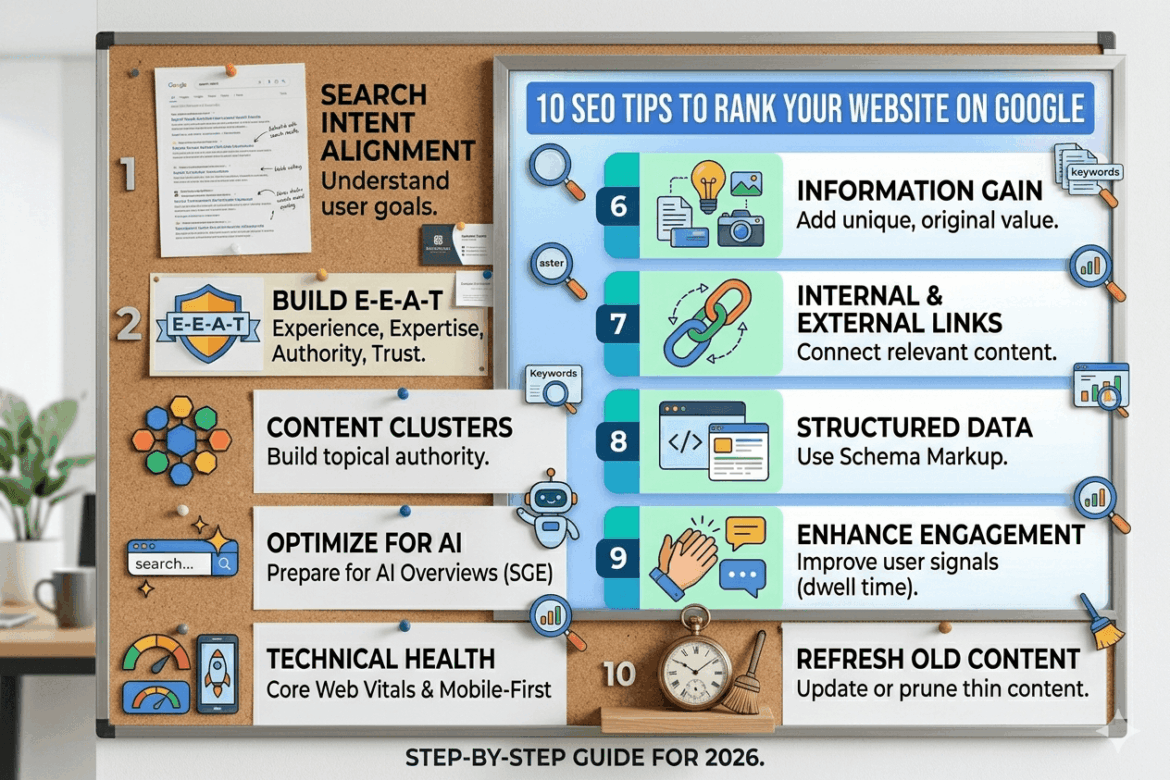
In the ever-evolving landscape of digital marketing, “Search Engine Optimization” is no longer just about peppered keywords and backlink counts. As we move through 2026, Google’s algorithms have shifted from simple indexing to deep content interpretation. With the rise of AI Overviews and Generative Engine Optimization (GEO), the goal isn’t just to be found—it’s to be recognized as the most helpful, authoritative source for a user’s specific problem.
If you want to move your website from the shadows of page two to the spotlight of the top results, you need a strategy built for the modern era. Here are the 10 most critical SEO tips to rank your website on Google today.
1. Master Search Intent Alignment
In 2026, Google cares less about what people type and more about what they want. If a user searches for “best DSLR cameras,” they are in a commercial investigation phase. If you provide a page that tries to sell them one specific camera immediately (transactional intent), you likely won’t rank.
Action Step: Before writing, search your target keyword. Are the top results “How-to” guides, product listings, or comparison tables? Mirror that format. Google’s AI rewards pages that satisfy the “post-click expectation”—meaning the user doesn’t need to hit the “back” button to find a better answer.
2. Prioritize E-E-A-T (Experience, Expertise, Authoritativeness, Trustworthiness)
Google’s Search Quality Rater Guidelines have placed a massive emphasis on the first “E”: Experience. In an era flooded with generic AI-generated content, Google prioritizes authors who can prove they’ve actually done what they’re writing about.
-
Show, don’t just tell: Use first-person language (“In my testing,” “We found that…”).
-
Author Bios: Every post should have a clear author box linked to a detailed bio page showcasing professional credentials and social proof.
-
Fact-Checking: Cite reputable sources and provide outbound links to high-authority domains.
3. Build Topical Authority with Content Clusters
Isolated blog posts are a relic of the past. To rank for competitive terms, Google needs to see your site as a “subject matter expert.” This is achieved through Content Clustering.
Instead of writing one giant post about “Digital Marketing,” create a “Pillar Page” and surround it with “Cluster Content”:
-
Pillar: The Ultimate Guide to Digital Marketing.
-
Clusters: SEO Tips, PPC Strategies, Email Marketing Automation, and Content Strategy.
-
The Glue: Interlink all cluster posts back to the pillar and vice versa. This tells Google’s crawler that you have covered the topic from every conceivable angle.

4. Optimize for AI Overviews (SGE/GEO)
Google’s search results now frequently lead with an AI-generated summary. To appear as a cited source in these overviews, your content must be “extractable.”
Action Step: Use the “Answer-First” approach. At the beginning of your post or section, provide a concise 50–80 word summary that directly answers the primary question. Use bullet points and clear H2/H3 headings. If the AI can easily parse your answer, it’s more likely to feature your site as a citation.
5. Enhance Technical Health and Core Web Vitals
You can have the best content in the world, but if your site takes five seconds to load on a mobile device, you will fail. Technical SEO is the “silent” ranking factor.
-
INP (Interaction to Next Paint): This newer metric measures how quickly your site responds when a user clicks a button or interacts. Ensure your Javascript is optimized.
-
Mobile-First Indexing: Google looks at your mobile site first. Ensure your navigation is thumb-friendly and your images are compressed (WebP format is best).
-
HTTPS: Security is a baseline requirement. Ensure your SSL certificate is active.
6. Focus on “Information Gain”
Google recently patented “Information Gain” scores. Essentially, if your blog post is just a rehash of the top three results currently on page one, Google has no reason to rank you. You aren’t adding value to the web.
How to improve your score:
-
Add original data or surveys.
-
Include unique images or infographics you created yourself.
-
Provide a contrarian perspective or a “lesson learned” that isn’t found elsewhere.
7. Strategic Internal and External Linking
Links are the “connective tissue” of the internet.
-
Internal Links: These help Google discover new pages and distribute “link equity” (ranking power) across your site. Use descriptive anchor text; instead of “click here,” use “advanced technical SEO guide.”
-
External Links: Don’t be afraid to link out. Linking to high-quality, relevant sources (like .gov, .edu, or industry leaders) signals to Google that you are part of a trustworthy neighborhood of information.
8. Utilize Structured Data (Schema Markup)
Schema markup is a code you put on your website to help search engines return more informative results for users. It doesn’t directly change your content, but it changes how Google understands it.
Common types of Schema to use in 2026:
-
FAQ Schema: To get your questions and answers directly into the SERPs.
-
Article/BlogPosting Schema: To help Google identify the headline, author, and date published.
-
How-To Schema: Perfect for step-by-step guides, often resulting in rich snippets that take up more “real estate” on the results page.
9. Improve Engagement Signals (The “Click-to-Value” Ratio)
Google monitors how users behave once they click your link. If someone clicks your result and immediately leaves (pogo-sticking), it’s a signal that your page didn’t satisfy them.
To keep users on the page:
-
Hook them early: Your introduction should promise a solution within the first two paragraphs.
-
Scannability: Use short paragraphs (2–3 sentences), bolded text for emphasis, and plenty of white space.
-
Multimedia: Embed relevant YouTube videos or audio snippets to increase “dwell time.”
10. Refresh and Prune Old Content
SEO is not a “set it and forget it” game. A post that ranked #1 in 2024 might be obsolete by 2026. Google loves Freshness.
-
The 80/20 Rule: 80% of your traffic likely comes from 20% of your posts. Audit these regularly. Update the stats, fix broken links, and add a “Last Updated” timestamp.
-
Pruning: If you have thin, low-quality posts from five years ago that get zero traffic, either update them, merge them into a larger guide, or delete them (and 301 redirect the URL). This “cleans” your crawl budget and focuses Google’s attention on your best work.
Conclusion: The Future is Human-Centric
Ranking on Google in 2026 requires a shift in mindset. We are moving away from “gaming the system” and toward solving for the human. By focusing on E-E-A-T, topical authority, and technical excellence, you create a website that Google wants to recommend.
SEO is a marathon, not a sprint. Implement these ten tips consistently, monitor your progress in Google Search Console, and adapt as the data flows in.
